← Back to selected work Independent project · End-to-end product & architecture · iOS & Android

Hakeemi .

Care, without the runaround.

A mobile app for finding a clinician and booking a visit — in English or Arabic, in light or dark mode, on iPhone and Android.

Hakeemi is an end-to-end portfolio product taking a healthcare booking experience from visual identity and design-system primitives to a tested, production-architected React Native application. Every clinician and appointment in the app is fictional demo data built to run locally against the Firebase Emulator Suite or a live Firebase project.

245 Automated tests

52 Jest suites, Cloud Functions unit tests, and Firestore Security Rules tests in CI

EN · AR Native RTL engine

Typed bilingual catalogues, CLDR plural rules, and full right-to-left layout mirroring

0.88 / 58 RN & Expo SDK

React Native 0.88, React 19, Expo SDK 58 with Continuous Native Generation and strict TypeScript

ACID Transactional slots

Server-side Firestore transactions in Cloud Functions prevent double-booking

01 / Product walkthrough

See it in motion.

80-second captioned walkthrough with sound: onboarding, demo mode, clinician search, 14-day availability calendar, transactional booking, rescheduling, cancellation, native Arabic RTL, and dark mode.

02 / Product & interface tour

Every flow, end to end.

Key user flows, states, and interface details across the application.

01

A complete product, not a screen mock-up

Sign-up, clinician search, specialty filtering, two-step booking, rescheduling, cancellation, calendar export, reminders, and persisted preferences all work end to end.

02

Zero-friction demo mode

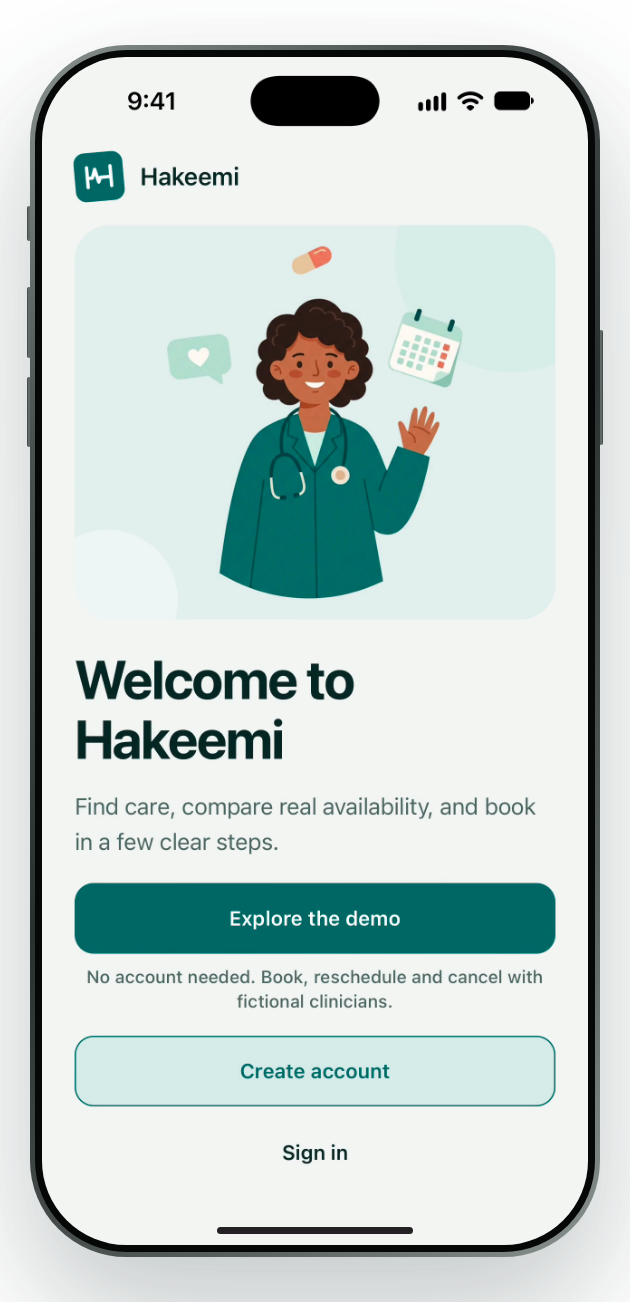
Recruiters and reviewers can tap “Explore the demo” on the welcome screen to test booking, rescheduling, and cancelling immediately without creating an account.

03

Built to be relied on

Two patients can never double-book the same slot, offline-aware caching keeps schedule data readable on poor connections, and Dynamic Type scales cleanly up to 2×.

04

One codebase, two platforms

Ships from a single strict-TypeScript React Native codebase to iOS and Android using Expo Router native tabs and Continuous Native Generation.

Welcome screen with an instant demo mode button, original clinician illustration, and account options
01 / Instant demo onboarding

Try the entire booking, rescheduling, and cancellation flow in one tap without creating an account.

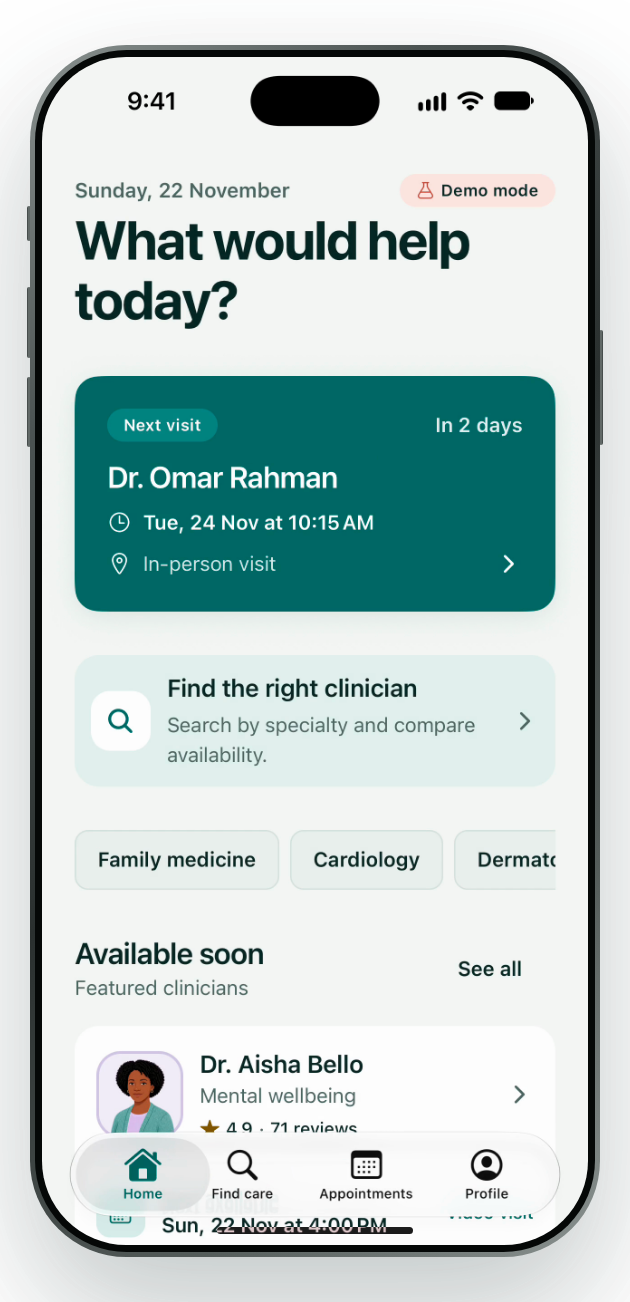
Home screen showing the upcoming visit card, specialty filters, and featured clinicians
02 / Home & next visit

Surfaces the next confirmed appointment at a glance alongside specialty quick-filters and available clinicians.

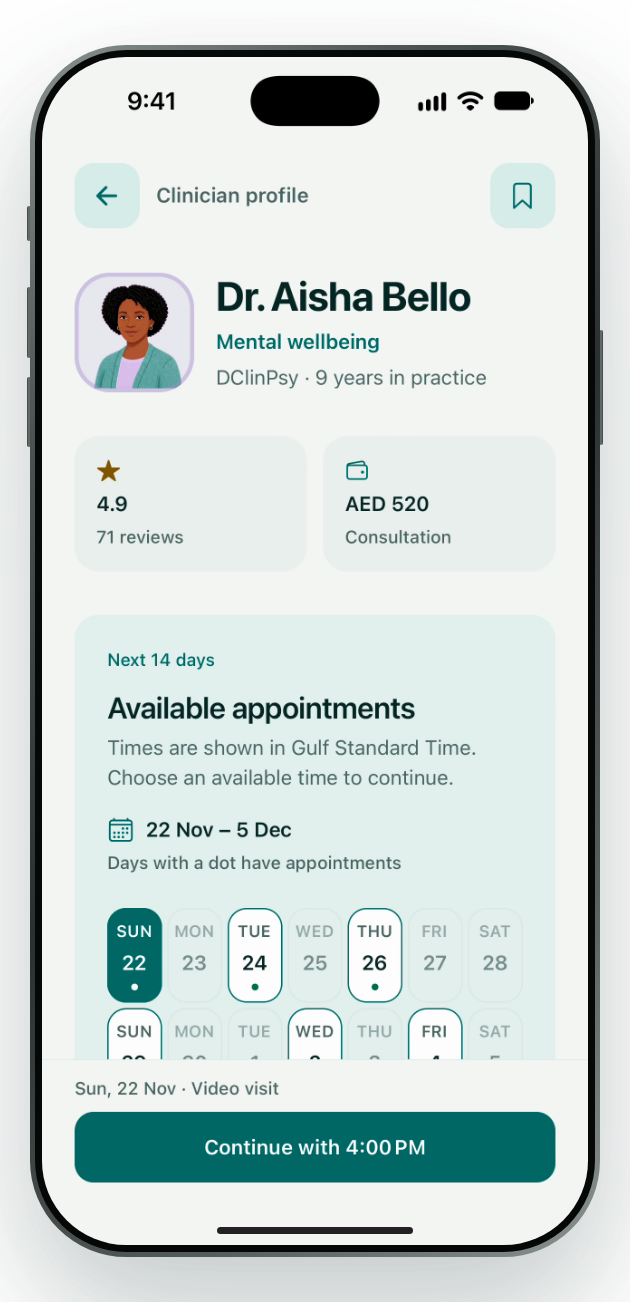
Clinician profile with a two-week calendar of open appointment dates and times in Gulf Standard Time
03 / Two-week availability

Displays 14 days of live open slots in Gulf Standard Time with dot indicators for days with openings.

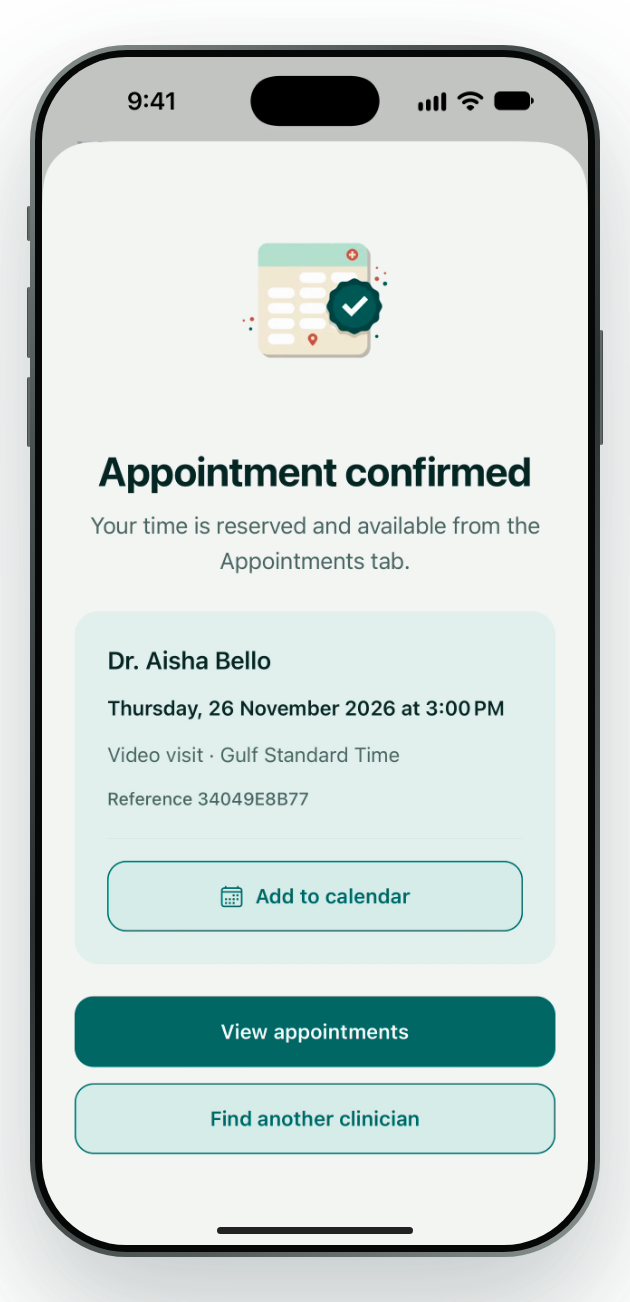
Appointment confirmed screen with booking reference, visit details, and add-to-calendar action
04 / Server-confirmed booking

A slot is reserved only after a Cloud Functions Firestore transaction verifies and locks the time.

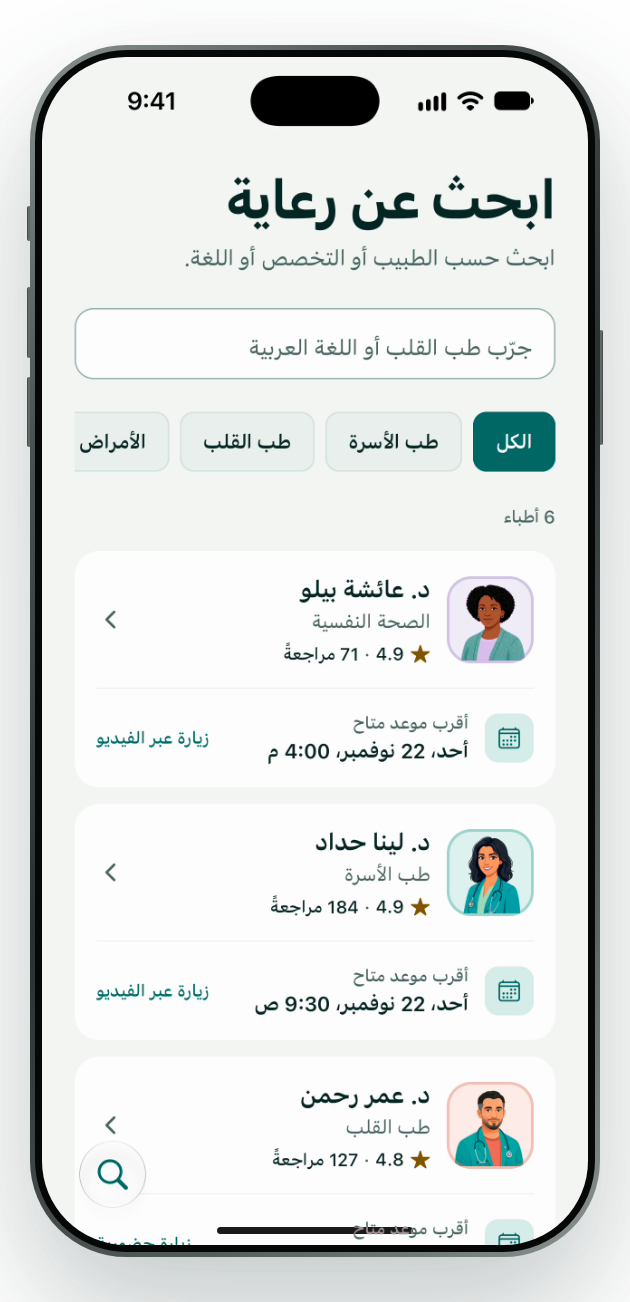
Clinician search screen in Arabic with a native mirrored right-to-left layout and specialty filters
05 / Native Arabic RTL

One tap switches the entire app to Arabic with mirrored flex layouts, bilingual clinician data, and CLDR plural rules.

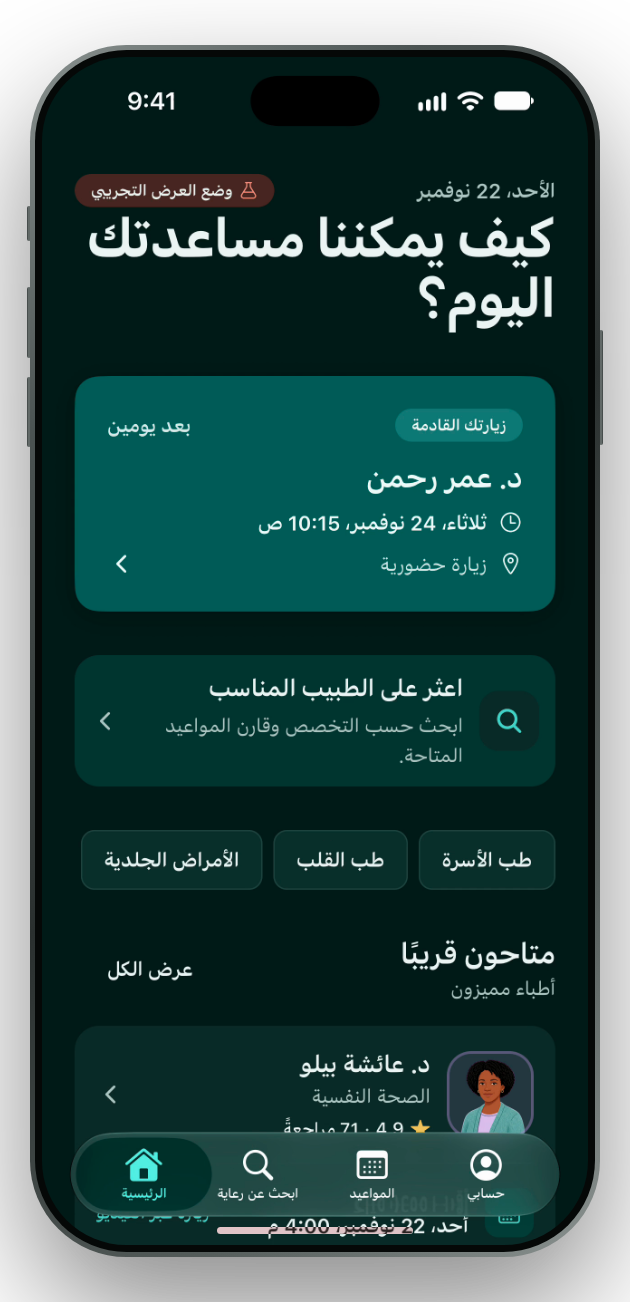
Home screen in Arabic with the dark theme enabled and synchronized status and navigation bars
06 / Bilingual dark mode

Semantic theme tokens flip the interface, system status bar, and translucent tab bar simultaneously.

03 / Under the hood

Engineered like production.

Architectural choices, state boundaries, and verification strategy for technical reviewers.

01 / Server-enforced transactional booking (No double-booking)

Booking, rescheduling, and cancellation execute inside Cloud Functions as atomic Firestore transactions. Firestore Security Rules block clients from writing appointment slot state directly, eliminating race conditions between concurrent users.

Read ADR 0003 on GitHub

02 / Feature-owned architecture behind platform adapters

Each feature directory under src/features/ owns its UI components, domain types, repositories, and tests. Native Firebase SDKs sit behind typed adapter interfaces so the exact same feature code runs on iOS, Android, Web, and inside Jest.

Read ADR 0001 on GitHub

03 / Native right-to-left (RTL) & bilingual domain model

Rather than bolting on translation strings, Hakeemi pairs typed English/Arabic string catalogues with bilingual clinician records, CLDR plural rules, mirrored directional icons, and synchronized system status and navigation bars.

Explore source on GitHub

04 / Offline-aware caching & accessibility tested in CI

Cached query reads keep appointments and clinician profiles available when connectivity drops. Design-system primitives enforce 44pt minimum touch targets, screen-reader labels, reduced-motion compliance, and automated WCAG contrast assertions in the test suite.

Read ADR 0004 & Testing Strategy
Technical stack

Core layers & tooling

Application
React Native 0.88, React 19, Expo SDK 58, TypeScript (strict)
Navigation
Expo Router with statically typed routes and native tab navigation
Backend & Auth
Firebase Auth, Cloud Firestore, Cloud Functions, Security Rules, Cloud Messaging
Server State & Validation
TanStack Query with offline-aware caching and Zod schema validation at the Firestore boundary
Forms
React Hook Form paired with shared Zod domain schemas
Quality & Testing
Jest, React Native Testing Library, Firebase Emulator Suite, ESLint, Prettier, Expo Doctor
Build & Delivery
Expo development builds with Continuous Native Generation (CNG) and EAS build profiles
Data & state pipeline

From screen to data & services

  1. 01
    Expo Router Screens

    Typed file-based routes in src/app/ with native tab bars and deep-linkable parameters

  2. 02
    Feature Hooks & Contexts

    Domain workflows in src/features/ for discovery, booking, appointments, auth, and preferences

  3. 03
    TanStack Query + Zod Repositories

    Cache orchestration, optimistic/invalidated queries, and strict runtime payload validation

  4. 04
    Platform & Fixture Adapters

    React Native Firebase adapters on device; deterministic fixture/emulator adapters on web and Jest

  5. 05
    Firebase Backend

    Auth, Firestore collections locked by Security Rules, and transactional Cloud Functions

Repository structure

Feature-owned codebase layout

src/app/
Expo Router routes and navigation layouts
src/components/ui/
Accessible design-system primitives (44pt targets, Dynamic Type)
src/features/
Feature-owned UI, domain models, repositories, and unit tests
src/services/
Firebase initialization and TanStack Query infrastructure
src/theme/
Semantic tokens, light/dark themes, and automated contrast checks
firebase/
Firestore Security Rules, composite indexes, seed catalogue, and rule tests
functions/src/
TypeScript Cloud Functions for transactional booking, rescheduling, and reminders
docs/
Architecture Decision Records (ADRs), testing strategy, and verification logs
Run it locally

Zero-credential local setup

Everything runs locally against the Firebase Emulator Suite seeded with the fictional clinician catalogue — no Firebase account or cloud credentials required.

npm install && npm --prefix functions install
cp .env.example .env
npm run firebase:emulators:seeded
npx expo prebuild --clean && npm run ios
Project lineage

Hakeemi began in 2021 as a bare React Native 0.64 project (preserved under the legacy-v1 tag on GitHub). This release is a ground-up rebuild on Expo SDK 58 and React Native 0.88 with an original visual identity, custom illustrations, transactional backend functions, and a 245-test verification suite.